

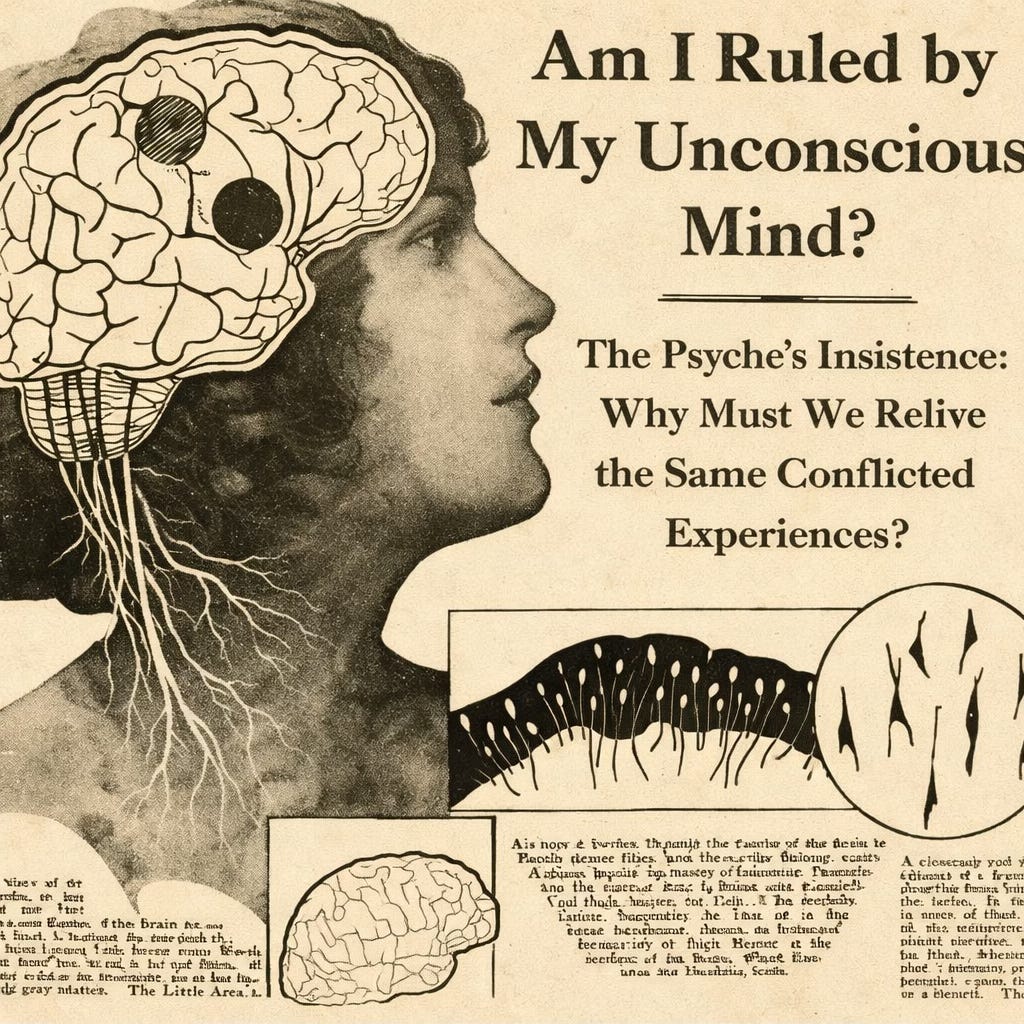
You notice it again.
That familiar pull inward, the way the same discomfort begins to gather in the chest or the throat when a conversation turns toward something tender.
The reluctance to let someone closer than a certain distance.
The instinctive reserve that appears just as real vulnerability starts to feel within reach.
The subtle tension that builds in the same places, with the same people, or even with entirely new people who somehow manage to recreate the old conditions without meaning to.
These repetitions arrive, steadily and persistently, across months and years, through different relationships and different seasons of life. They come without invitation, feel almost inevitable, carry a familiarity that is both strangely comforting and profoundly draining. The psyche seems to insist on returning to this territory again and again. As though something essential has been left unfinished. As though the heart, or something deeper still, continues to believe that if the same scene can be replayed just one more time, the ending might finally change.
The wound might close.
The longing might find the response it has always sought.
The soul keeps circling the same ground, because subconsciously, it still holds an enduring hope that resolution is possible.
The Nature of the Compulsion
The psyche does not pursue the new simply because it is new. It returns repeatedly to what has been left unresolved. Sigmund Freud gave this tendency the name repetition compulsion. In Beyond the Pleasure Principle he described a compulsion to repeat that overrides the pleasure principle. He observed that people bring back experiences which hold no possibility of pleasure. Experiences that could never serve as satisfactions. Even for long-repressed impulses.
The repetition does not stem from enjoyment of the pain or stupidity of any kind, it arises because the unconscious insists on re-presenting material that was once too much to absorb completely. The pattern recreates itself in the here and now. So that what was once repressed can at last find a way to be expressed. So that it can be mastered. Or resolved in some meaningful form.
Freud expressed it with stark clarity:
“The patient cannot remember the whole of what is repressed in him, and what he cannot remember may be precisely the essential part of it. He is obliged to repeat the repressed material as a contemporary experience instead of remembering it as something in the past.”
- Sigmund Freud
Roots in Early Attachment
This mechanism takes root very early. Attachment provides the framework within which everything else organises itself.
When caregiving is inconsistent. When warmth appears and disappears without reliable pattern. When the child’s needs are met only after careful adjustment or are left unmet. The nervous system responds with extraordinary accuracy. Needs begin to contract. Expectations diminish. The child learns to anticipate rather than to ask. To regulate the self rather than to turn outward. Competence develops at a very early age. A certain composure forms before its time. Praise comes for the child’s ability to manage. For the minimal disturbance caused.
Beneath this composure lies a burden of considerable weight. The child has come to understand that dependence involves risk. Closeness carries uncertainty. Open request may lead to disappointment or withdrawal. The adaptation therefore becomes firm. Self-reliance emerges as the path of least danger.
John Bowlby explained this through the concept of internal working models in attachment theory. These are mental representations of the self and others, constructed from repeated interactions with caregivers. They establish expectations about whether others will respond reliably, whether the self deserves care, whether vulnerability will result in connection or in rupture. Once these models are in place they direct perception and behaviour across the lifespan. They filter incoming experience. They guide the individual toward circumstances that reaffirm the early assumptions. Even when that reaffirmation brings pain.
How Patterns Recreate Themselves in Adulthood
In adulthood the unconscious carries on its programmed, unconscious task. It chooses partners. It selects dynamics. It draws in situations that mirror the early conditions. A relationship may begin with real promise, then the familiar tensions emerge. Withdrawal appears on one side, vigilance heightens on the other.
Hope rises once more. This time the story will surely unfold differently. This time closeness may prove steady. Needs may meet with consistent response.
The repetition serves a purpose of profound depth. It seeks belated repair. It attempts to rewrite the script of the original wound.
The nervous system interprets the familiarity as a form of safety. Even when the familiarity inflicts suffering. Chronic tension lodges in muscles and in the breath. Relationships progress to a certain depth, then they level off.
Irritation appears over matters that once seemed minor. Loneliness endures. Not because others are absent, but because presence in relationship stays partial. The mechanism that once secured survival now constrains the possibility of authentic connection.
The Deeper Purpose: Hope and Wholeness
Yet the repetition itself discloses something vital. It reveals the psyche’s stubborn and enduring hope. Beneath the suffering exists a conviction held at the deepest level. The unmet need from childhood may yet be fulfilled. The younger self who learned to manage independently may one day find safety in reliance on another.
The compulsion constitutes an unconscious movement toward wholeness. Toward the integration of what has remained fragmented.
In analytical psychology this recurrent return to old wounds indicates the psyche’s broader trajectory toward individuation. The unconscious brings the conflict forward again not to imprison the person, but to compel conscious engagement. To convert unconscious suffering into something that can be known. Something that can be born in a different way. The pattern persists because it carries meaning, it bears the unfinished narrative that still seeks its ending.
The loneliness that accompanies them speaks to an old solution that once made perfect sense. Now asking to soften.
Moving Toward Awareness
When the familiar discomfort appears, we can meet it with curiosity.
What earlier relational experience does this moment reflect?
What need once rendered this adaptation essential?
The simple act of naming the repetition begins to reduce its automatic power. The unconscious ceases to operate wholly in the shadows.
The nervous system starts to differentiate between historical threat and current reality.
Adult capacities are present now, resources that were unavailable to the child self.
Choices can expand slowly.
Interdependence becomes possible without immediate withdrawal into self-sufficiency.
This process requires no sudden transformation. The psyche formed over decades of caution cannot alter in an instant. Patience is required. Observation free from severe judgement. Recognition of the pattern’s original intelligence.
The repetition once addressed genuine uncertainty. That child existed in conditions that demanded constant watchfulness. The adult inhabits different circumstances. The adult possesses the ability to meet needs in ways the child did not.
Final Reflections
The return to old patterns indicates that something remains unresolved. It indicates that the psyche continues its search for completion.
Within that persistent search lies the genuine possibility of change. Not through exertion of will alone. Not through abrupt revelation. But through prolonged and compassionate attention. Through permitting the pattern to disclose its underlying intention.
The repetition. Painful as it continues to be. Contains the seed of healing. It holds the lasting wish for wholeness. When that wish encounters understanding rather than opposition. Something begins to change.
The way forward becomes clearer. Presence deepens. Life progresses. Slowly. Steadily. Toward greater authenticity and depth. The old adaptation, once indispensable, can at last begin to rest. The psyche, ever seeking, can discover a degree of peace.